
Nutrition for lifelong health, whatever your path
Supporting people through bariatric surgery, weight loss medications,
and diet & lifestyle modification.
The Eat Bari Well Blog:
Why Weight Loss Gets Harder: The Biology Behind Obesity, Plateaus & Regain
For decades, people living with obesity have been fat-shamed and told to “just eat less and move more.”
But the science tells a much more complicated story.
Many people have heard terms like set point, metabolic adaptation, or hunger hormones, but what do they mean?
The first thing to understand is that body weight is not regulated by willpower alone.
Your brain is constantly receiving information about:
- how much stored energy you have
- how much food is coming in
- how much energy you are using
- hunger and fullness
- your environment, habits, sleep, stress and activity
Hormones are part of that communication system.
One of them is leptin.
What leptin normally does
Leptin is produced mainly by fat cells and helps tell the brain how much stored energy is available.
Think of leptin like the fuel gauge in your dashboard. It indicates whether fat stores are full or running low.
But it doesn’t suddenly drop because you missed a meal – it tracks long-term reserves. With ongoing calorie restriction, leptin levels will drop.
In simple terms, when energy stores are plentiful, leptin tells the brain:
“We have enough energy stored.”
It is one of many signals involved in appetite, satiety (fullness & satisfaction) and longer-term energy balance. But in chronic obesity, that signalling can change.
What changes in obesity?
As fat tissue increases, leptin levels generally increase too.
But instead of the brain responding by reducing appetite and bringing weight back down, many people with obesity develop leptin resistance.
When this occurs, the brain becomes much less responsive to leptin – and interprets this as: “ Uh oh! Our energy stores are dropping.”
The response is a general decrease in satiety (fullness & satisfaction) - rather than at one given meal.
At the same time, other changes often occur:
- insulin resistance becomes more common
- more glucose may be stored as fat instead of burned as fuel
- other hormones affecting appetite signalling are altered – there may be increased hunger and/or decreased fullness & satisfaction
- the body may become less metabolically flexible & may not burn fat as efficiently
- energy storage may become favoured over burning fuel
- the brain and body may increasingly defend a higher body weight
You may have heard this described as having a higher “set point.”
That term is useful, but it can be misleading if we imagine one exact number that the body is programmed to maintain.
A better way to think about it is a defended weight range.
The body can use changes in appetite, hormones, energy expenditure and behaviour to resist significant changes in weight, particularly significant weight loss.
This is one reason obesity is considered a chronic disease, not simply a problem of motivation or discipline.
For some people this can be oddly reassuring. After a lifetime of struggle, understanding these mechanisms helps show that in fact, the odds may have been stacked against you.
So what does happen when you lose a significant amount of weight?
Whether weight loss happens through lifestyle changes, bariatric surgery, medication, or some combination of these, your body has now lost a substantial amount of stored energy.
You may be thrilled about that.
Your biology, however, tends to see it as a threat.
Here are some of the ways your body aims to protect against that perceived threat:
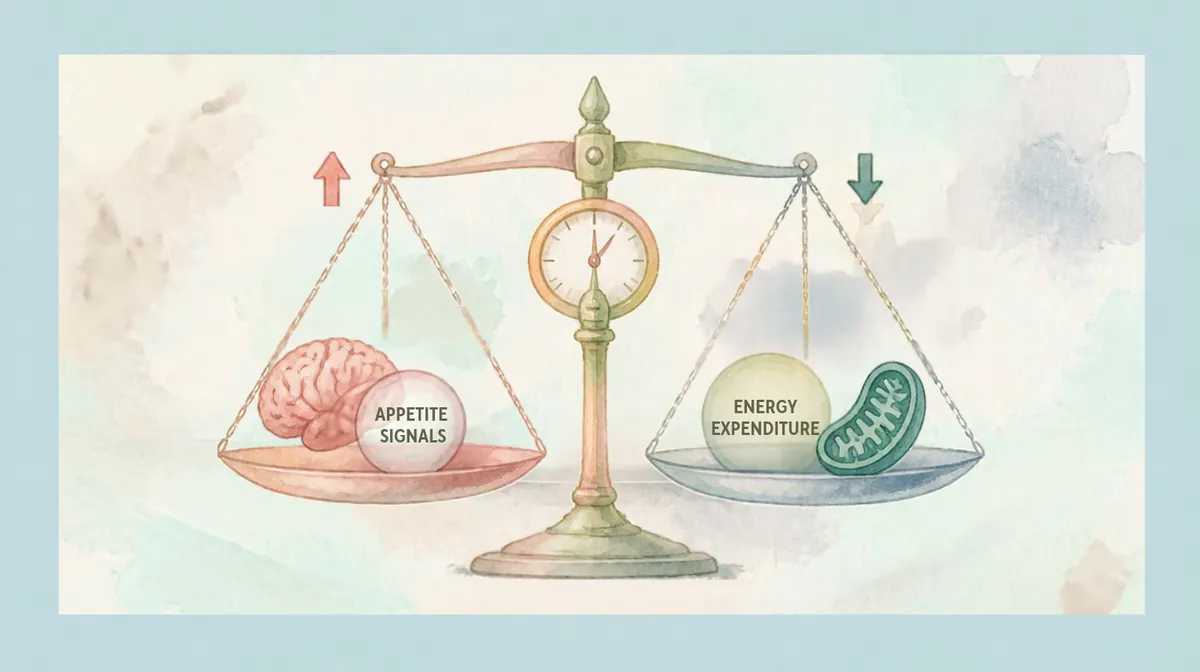
Your energy needs decrease
A smaller body naturally needs fewer calories than a larger body.
That part is expected.
But in some people, the body also reduces energy expenditure more than we would predict from the change in body size alone.
This is called adaptive thermogenesis, or metabolic adaptation.
In other words, the body becomes more energy-efficient.
Appetite signals may change
As body fat decreases, leptin levels also fall (reduced satiety).
Other appetite and satiety signals can change too.
For example, a hormone called ghrelin may increase – which leads to increased hunger.
Depending on the person and the type of treatment, hormone signalling changes can mean:
- more hunger
- less fullness or satisfaction
- more interest in food
- stronger food-seeking behaviour or cravings
- more difficulty maintaining a calorie deficit
The body may also conserve energy in less obvious ways.
You may move less, fidget less, or become more efficient during everyday activity without consciously choosing to do so.
Put all of this together and you can see why weight loss often slows.
And why maintaining a large weight loss can be harder than expected.
But the biology is not identical for everyone
This is where things get more interesting.
How the body responds depends partly on how the weight was lost.
If weight loss comes mainly through diet and lifestyle
When calorie intake is reduced and weight is lost through lifestyle changes alone, the body’s compensatory responses can be quite strong.
Appetite may increase.
Satiety may decrease.
Energy expenditure may fall.
The body may biologically push back against continued loss and work to restore some of the weight.
This does not mean lifestyle changes are unimportant.
Nutrition, physical activity, sleep, strength training and behaviour remain foundational to health and long-term weight management.
But they are working within a biological system that may be resisting further weight loss.
If weight loss comes through bariatric surgery
Bariatric surgery does much more than simply make the stomach smaller.
Different procedures affect the body in different ways, but generally surgery can alter things like:
- gut-brain signalling
- hunger and satiety
- gastrointestinal hormones
- food preferences
- glucose regulation
- how quickly food moves through the digestive system
- the biological drive to eat
- for some procedures, how much energy and nutrients are absorbed
This helps explain why bariatric surgery can produce much greater and more sustained weight loss than lifestyle intervention alone for many people.
But surgery does not make someone permanently immune to the biology of obesity.
Over time, appetite can change.
Portions may increase.
Weight loss may slow or plateau.
Some regain is common.
Nutrition needs also change as someone moves from the early post-operative period into long-term maintenance.
That is why bariatric care does not end when the surgical weight-loss phase ends.
It’s also why having clear expectations and strategies for long-term maintenance matter.
If weight loss comes through medication
Modern weight-loss medications also work through biological pathways involved in appetite, satiety and energy intake.
For many people, they can:
- reduce hunger
- increase fullness
- reduce food preoccupation or “food noise”
- make it easier to eat less without constantly fighting appetite
This is important because it means the medication is not simply helping someone “try harder.”
It is changing some of the biological signals that previously made weight loss incredibly difficult.
But if the medication is reduced, stopped, or becomes less effective, some of those biological pressures are likely to return.
Hunger may increase.
Food noise may return.
Maintaining the previous calorie intake may become more difficult.
Weight regain becomes more likely for some people.
This does not mean that you are powerless.
But it does mean that ongoing care still matters.
None of these tools “cure” obesity
Lifestyle intervention, bariatric surgery and weight-loss medication work in different ways.
Sometimes they are used alone.
Sometimes they work best in combination.
But none of them makes the underlying biology of obesity disappear permanently.
That is why it helps to move away from the idea that treatment looks like:
Start treatment → lose weight → reach goal → done.
For most people, it is much more realistic to think of obesity care as something that evolves over time.
You may need different tools at different stages.
Sometimes progress will be fast.
Sometimes slow.
Sometimes weight will stay stable for a long time.
Sometimes it may move backwards.
And sometimes what worked beautifully several years ago may no longer be enough on its own.
This is why maintenance matters
The goal is not to spend the rest of your life chasing a number on the scale.
It is to protect what you gained from treatment.
That may include:
- maintaining as much of your weight loss as possible
- protecting lean muscle and bone mass
- maintaining good nutrition and preventing deficiencies
- preserving improvements in blood sugar, blood pressure, mobility, energy and other measures of health
- reducing long-term health risks
- maintaining a workable relationship with food
- preserving confidence, function and quality of life
And if things begin to change?
That does not automatically mean you have failed.
It means something deserves another look.
Your nutrition may need to change.
Your activity may need to change.
Your medication may need to be reassessed.
You may benefit from additional support.
Or you may simply need help understanding what your body is telling you now.
Obesity care is ongoing care.
And ongoing does not mean doing the same thing forever.
It means having options, adjusting when your needs change, and continuing to protect both your weight-related progress and your health over the long term.
What role do I play?
At Eat Bari Well, I focus on the nutrition aspect of bariatric care.
That means I provide clinical guidance to people living with obesity – no matter which treatment approach they pursue.
I provide nutritional education, online programs, meal plans and recipe collections, nutrition audits, and private coaching to people at all different stages of their journey.
Here’s How I Can Support You
Whatever your treatment path or stage, I offer several ways to help:
Whether your path includes surgery, medications, diet and lifestyle modification - or any combination of these treatment options - I also offer a Nutrition Audit and private coaching for anywhere along the journey.
Nutrition Audit
A personalized nutrition assessment with a live review, detailed report, and customized action plan that targets the most impactful next steps.
Private Coaching
Ongoing one-on-one support for Nutrition Audit clients who want to go deeper, work toward a specific goal, and make adjustments in real time.
If surgery becomes part of your plan, preparation matters.
Bariatric surgery is not just a physical procedure—it’s a psychological and relational transition. Understanding what will change and what kind of support you’ll need can make a meaningful difference in how the experience unfolds.
If you’re leaning toward surgery—or even just exploring it—preparation matters.
Bariatric Power Prep is a 6 week online program, that was created to help you understand what’s ahead, and prepare in a way that supports long-term success.
If you aren't quite ready for that, but would like to explore Bariatric-style eating, I've got a 7-Day Sample Meal Plan that would make an excellent first step.
Frequently Asked Questions
Is bariatric surgery better than GLP-1 medications like Ozempic or Wegovy?
There is no universally “better” option. Bariatric surgery tends to produce greater and more durable weight loss, while medications offer a non-surgical option that can be very effective for many people. The best choice depends on your health history, treatment goals, preferences, access, and what feels sustainable for you over time.
Can you use GLP-1 medications and bariatric surgery together?
Yes. Many people use more than one treatment tool over time. Weight-loss medications may be used before surgery, after surgery for additional weight loss or regain, or later as part of ongoing obesity treatment. The timing and choice should be individualized with your medical team.
Are GLP-1 medications meant to be taken long-term?
For most people, yes. Current evidence suggests that maintaining the benefits of these medications usually requires ongoing treatment, although dosing strategies and long-term maintenance approaches continue to evolve.
What’s the difference between sleeve gastrectomy (VSG) and gastric bypass?
Sleeve gastrectomy reduces stomach size and affects appetite and satiety signals, while gastric bypass also changes the route food takes through the digestive system and alters absorption to a greater degree. Both are well-established bariatric procedures, and the best choice depends on your health history, weight-loss goals, reflux, metabolic conditions, and other individual factors.