
Nutrition for lifelong health, whatever your path
Supporting people through bariatric surgery, weight loss medications,
and diet & lifestyle modification.
The Eat Bari Well Blog
What Is Food Noise?
The Science, the Debate, and What May Help
Is it different from hunger or cravings? What do GLP-1 medications teach us? And what do we actually know?
By Jennifer Baer, Registered Nutritionist & Bariatric Specialist
"I used to think about food ALL the time.
What should I eat? When can I eat again? What's for dinner? It felt like my brain never stopped thinking about food."
And then, for many people who began taking GLP-1 weight-loss medications, something remarkable happened.
The constant thoughts quieted.
Some described being able to walk past the kitchen without thinking about what they could eat. Others said they could leave food on their plate without feeling compelled to finish it.
Some hadn't even realized how much mental energy they'd been spending thinking about food until those thoughts became less intrusive.
They started calling it "food noise".
The term quickly spread through social media, patient communities and news articles. Eventually, it made its way into clinical conversations and scientific research.
And it's easy to understand why.
For someone who has experienced persistent, exhausting thoughts about food, having a name for that experience can feel incredibly validating.
But here's where things get interesting.
Just because we've given an experience a name doesn't necessarily mean we fully understand what causes it.
And when something is repeated often enough, particularly across social media and health-related marketing, an emerging theory can gradually start sounding like an established scientific fact.
So what exactly is food noise?
Is it different from hunger or cravings?
Is it biological, psychological or both?
Can it be reduced through nutrition, or does it require medication?
And perhaps most importantly, what does the science actually tell us?
Let's take a closer look.
First, what exactly is "food noise"?
Food noise generally refers to persistent, intrusive or unwanted thoughts about food that can become distracting, distressing or difficult to manage.
It's not simply enjoying food, planning dinner or occasionally craving something delicious.
It's the experience of food-related thoughts taking up more mental space than you want them to.
What does food noise feel like?
People describe experiences such as:
- Constantly thinking about what they'll eat next, even shortly after eating
- Mentally negotiating whether, when or how much to eat
- Repeatedly thinking about cravings or particular foods
- Feeling distracted by food even when they aren't physically hungry
- Spending considerable mental energy trying to control or manage eating
- Finding that thoughts about food interfere with concentration, activities or enjoyment of life
For some people, this can feel like an ongoing internal conversation that's difficult to turn off.
In a 2025 paper published in Nutrition & Diabetes, researchers proposed a more formal definition centred on persistent food-related thoughts that feel unwanted or distressing and may negatively affect someone's well-being.
That distinction matters.
The concern isn't necessarily how often you think about food. It's whether those thoughts feel intrusive, distressing or difficult to manage.
However, this scientific definition is relatively new.
And researchers don't yet agree about whether food noise is a distinct phenomenon or a new way of describing several experiences we already know about.
Food noise versus hunger: Are they really different?
This is probably the most common distinction you'll hear.
Physical hunger is generally described as your body's signal that it needs nourishment.
Food noise, on the other hand, is often described as thinking about food even when you're not physically hungry.
It's a useful starting point, but I think it oversimplifies a very complicated process.
Hunger doesn't always announce itself as a growling stomach.
It might show up as irritability, reduced concentration, fatigue, thoughts about food, or a growing desire to eat.
And hunger isn't determined solely by whether your stomach is empty.
Hormones, sleep, stress, energy availability, previous food intake, environmental cues and the brain's reward systems all influence when, how and why we want to eat.
Consider three different experiences:
Physical hunger: You haven't eaten for several hours, your energy is dropping, and you're increasingly thinking about lunch.
A food craving: You see or smell something delicious and suddenly find yourself wanting that particular food.
Persistent food preoccupation: You've eaten, you're reasonably satisfied, but you find yourself repeatedly thinking about food in a way that feels intrusive or difficult to control.
These may feel very different.
But that doesn't mean they arise from completely separate biological systems.
Someone might think frequently about food because they're undernourished, because certain foods are particularly rewarding, because they've spent years following restrictive diets, or because they're experiencing genuinely distressing food-related thoughts.
Sometimes several of those things are happening at once.
So while food noise may feel different from ordinary hunger or cravings, we can't assume the underlying processes are entirely separate.
And that brings us to one of the most interesting debates in the research.
Is food noise a new scientific discovery, or a new name for something we already understand?
Researchers have been studying food cravings, eating behaviour, food preoccupation, food reward and responses to food cues for decades.
What is relatively new is the widespread use of the term "food noise".
And this is where I think we need to be careful.
There's a tendency for an idea to be proposed, repeated and gradually accepted as fact, sometimes well before the underlying science has caught up.
Food noise is a good example of why it's important to distinguish between an experience, a hypothesis and an established scientific explanation.
The argument in favour
Researchers who support studying food noise as a distinct phenomenon argue that it may capture something important that existing measures don't fully describe.
The experience may involve not only hunger or cravings but also persistent, unwanted thoughts about food that create a significant cognitive and emotional burden.
Giving that experience a name can help people describe something they've struggled with for years.
It may also reduce stigma by challenging the assumption that eating behaviour is simply a matter of discipline or willpower.
And it provides researchers with an opportunity to investigate something that patients themselves have identified as meaningful.
These are compelling arguments.
The counterargument
In a 2026 paper published in Appetite, researchers raised several important questions:
Does food noise represent something fundamentally different from cravings, food preoccupation or intrusive thoughts?
Or are we combining several overlapping experiences under one new label?
The researchers also questioned whether existing measurement tools adequately distinguish food noise from established concepts.
And they raised another concern:
Could we unintentionally start treating ordinary thoughts about food as something pathological that needs to be eliminated?
I think that question deserves serious consideration.
Because recognizing an experience and explaining its cause are two different things.
Someone can genuinely struggle with intrusive food thoughts without those thoughts necessarily representing a distinct medical condition.
And the fact that an experience may overlap with other known processes doesn't make it any less important. Both perspectives deserve consideration.
What might actually explain food noise?
A 2026 theoretical review published online ahead of print explored five possible frameworks:
Energy regulation: The brain's responses to hunger, energy availability and the need for nourishment.
Food-cue reactivity: How strongly someone responds to the sight, smell, availability or anticipation of food.
Food addiction models: The possibility that certain reward-related processes contribute to persistent food thoughts.
Thought suppression: Whether trying hard not to think about food can sometimes make those thoughts more persistent.
Memory and cognitive inhibition: How the brain processes, retrieves and regulates food-related information.
These are proposed explanations, not five established causes of food noise.
And they aren't necessarily mutually exclusive.
The important point is that researchers are exploring several possibilities.
There isn't one universally accepted mechanism that explains why someone experiences persistent thoughts about food.
Food noise: What people are saying versus what the evidence actually shows
Here's where I find it helpful to distinguish between something that sounds plausible and something that has actually been demonstrated by research.
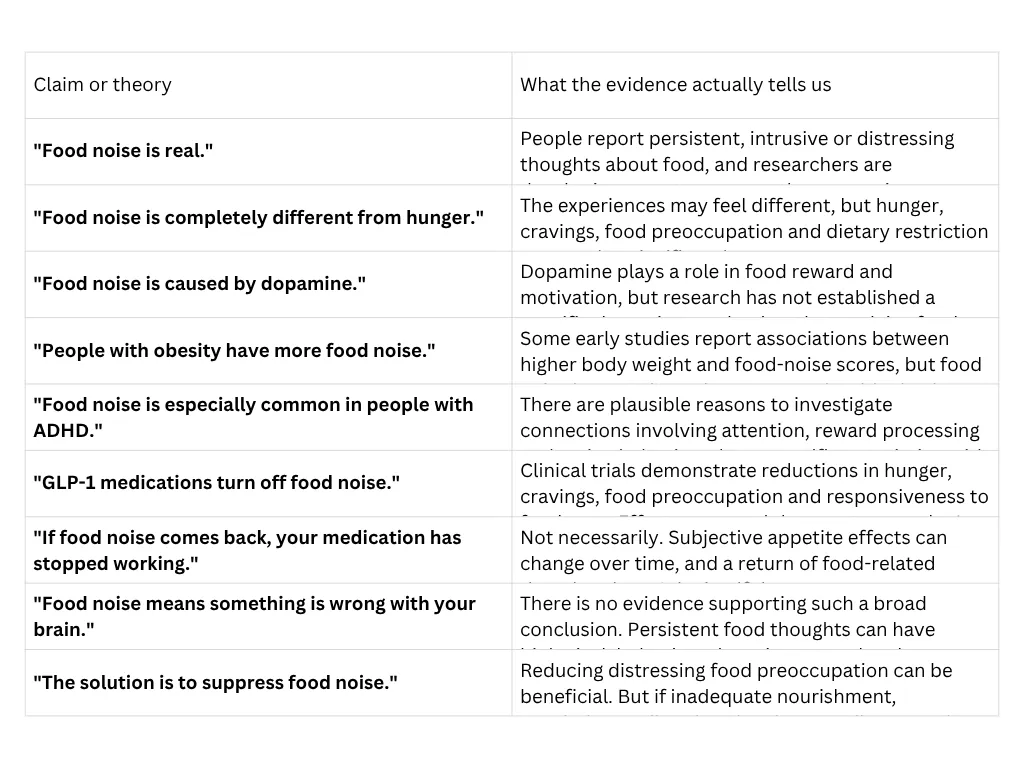
The distinction running through this table is important.
An explanation can sound entirely plausible without yet being established by research.
That doesn't make the explanation wrong. It means we need to keep asking questions.
What does the research actually show?
There are three especially interesting areas of research emerging.
1. Researchers are developing ways to measure food noise
In 2025, researchers published the development and initial validation of the Food Noise Questionnaire.
This five-question tool measures experiences involving food-related thoughts and their intrusiveness.
Researchers analysed responses from 396 participants and found promising results for reliability and validity.
In other words, the questionnaire appeared to measure a reasonably consistent experience.
That's an important step.
But there's a distinction between developing a questionnaire that reliably measures something and demonstrating that the experience represents a distinct medical condition. A questionnaire may consistently measure intrusive food thoughts while still overlapping substantially with existing concepts. Researchers have also developed the RAID-FN Inventory, another instrument intended to help characterize food noise.
These tools are valuable for studying the phenomenon. But their development doesn't mean we have a universally accepted diagnostic test or clinically meaningful threshold.
We have emerging tools for measuring food noise. We don't yet have an established clinical diagnosis.
2. How many people actually experience food noise?
A 2026 study from Penn State surveyed 1,000 adults in the United States.
Researchers found that approximately 18% reported experiencing food noise frequently or constantly.
That's nearly one in five people.
The study also found associations with experiences including dietary restriction, recent weight-loss attempts and loss of control over eating.
But there's an important limitation.
Participants were asked how frequently they experienced food noise using a description of the term.
Researchers weren't diagnosing a clinical condition.
They were measuring how many people identified with the experience they described.
Now consider a different study.
In a 2026 research preprint involving more than 3,600 U.S. adults, researchers used questionnaire-based definitions.
Depending on how food noise was defined, approximately 4% to 9.5% of participants met the study's criteria for food-noise endorsement.
That's a substantial difference from 18%.
Does that mean one study is right and the other is wrong?
Not necessarily.
The studies used different methods and definitions.
And the second study was a preprint, meaning its findings should be considered preliminary until they have completed peer review.
What I find particularly interesting is that the answer changes depending on what we're actually asking and how we're measuring it.
That's exactly why it's important not to turn an emerging prevalence estimate into a definitive statement about how many people have a particular condition.
3. GLP-1 medications really do influence more than physical fullness
One of the strongest reasons to investigate food noise comes from research on weight-loss medications.
People taking medications such as semaglutide (Ozempic/Wegovy) and tirzepatide (Mounjaro/Zepbound) frequently describe changes in hunger, cravings and their relationship with food.
Some describe the reduction in persistent food thoughts as one of the most noticeable effects of treatment.
And controlled clinical trials support several aspects of these experiences.
A 2021 randomized trial of semaglutide found improvements in appetite regulation, control of eating and food cravings compared with placebo.
A 2025 randomized trial of tirzepatide demonstrated reductions in hunger, cravings, tendency to overeat and responsiveness to food cues.
These findings are important because they show that weight-loss medications influence several interconnected aspects of eating behaviour. Not simply the amount of food someone can physically consume.
And newer research adds another interesting layer.
In a 2026 randomized trial examining semaglutide over 60 weeks, researchers found that participants taking semaglutide continued to consume less food than those receiving placebo throughout the study.
However, something interesting happened with some of the subjective appetite measures.
At 20 weeks, participants taking semaglutide reported significantly greater improvements in hunger and food preoccupation than those receiving placebo.
At 40 and 60 weeks, the differences between groups on those particular measures were smaller and no longer statistically significant.
That doesn't mean the medication stopped working.
It doesn't prove that everyone develops tolerance.
And it certainly doesn't mean that people inevitably return to their previous experiences of hunger or food preoccupation.
But it suggests that the way someone experiences hunger or food-related thoughts may change over time, even while a medication continues influencing food intake.
That's a fascinating finding, particularly for people who notice hunger or food thoughts becoming more noticeable during treatment.
It also raises an important scientific question.
If these medications influence hunger, cravings, food reward and eating behaviour, does that mean food noise is a distinct biological phenomenon?
Or could what we call food noise reflect changes across several familiar appetite-regulating processes?
We don't yet have a definitive answer.
An important counterargument: What if you're thinking about food because you're not eating enough?
This is the part of the conversation that I think deserves much more attention.
We often talk about persistent thoughts about food as though they're an unwanted problem that needs to be suppressed. But sometimes, thinking frequently about food is an entirely understandable response to not getting enough nourishment.
And this isn't a new discovery.
What decades of research on food restriction tell us
During the Minnesota Starvation Experiment in the 1940s, researchers observed profound changes in participants' relationships with food during prolonged dietary restriction.
Food became a major preoccupation.
Participants thought about it, talked about it, collected recipes and planned elaborate meals.
Many of these experiences continued during the early stages of nutritional rehabilitation.
A 2021 scientific review explored the psychological and behavioural effects of negative energy balance, drawing on research involving starvation, therapeutic weight loss and appetite regulation.
The review highlights how the body's responses to energy restriction depend on factors including the size and duration of the energy deficit, body composition and the surrounding psychological environment.
The intense effects of prolonged semi-starvation cannot simply be equated with ordinary intentional weight loss.
But this body of research does demonstrate something important:
Inadequate energy intake can affect much more than physical hunger. It can influence attention, motivation, emotions and food-seeking behaviour.
Now consider someone who has had bariatric surgery, is taking a weight-loss medication or is actively trying to lose weight.
Perhaps they're eating very small portions.
Perhaps they're prioritizing protein but struggling to include adequate amounts of other foods.
Perhaps they're regularly skipping meals because their appetite has been so suppressed.
Or perhaps they've spent years following restrictive diets and worrying about eating the wrong things.
If that person starts thinking about food more frequently, what exactly is driving those thoughts?
Is it food noise?
Is it physical or psychological hunger?
Is it the body's response to inadequate nourishment?
Is it anxiety or preoccupation related to dietary rules?
Or some combination?
We can't assume that every persistent thought about food represents an appetite signal that needs to be turned down. Sometimes, the more appropriate response may be to examine whether someone's nutritional needs are actually being met.
This doesn't mean all food noise is caused by under-eating.
And it certainly doesn't mean everyone who experiences distressing food thoughts can resolve them simply by eating more. But it does mean that nutrition deserves a place in the conversation before we automatically conclude that stronger appetite suppression is the answer.
Why the language we use matters
There's another reason I think this discussion deserves nuance.
For many people, the concept of food noise has been enormously helpful.
It gives language to an experience they may have struggled to describe.
It can also challenge the idea that eating behaviour is simply a matter of self-control or willpower.
Those are meaningful benefits.
But I also worry about what happens when the conversation shifts from:
"I experience persistent thoughts about food that sometimes interfere with my life."
To:
"Thinking about food means there's something wrong with my brain."
Those are very different statements.
The first describes an experience.
The second assigns a cause and implies a problem.
And when we start treating every desire to eat, craving or thought about food as something that needs to be suppressed, we risk losing sight of something fundamental.
Food is supposed to be part of our lives.
We should be able to enjoy it.
Look forward to meals.
Think about something delicious we'd like to cook.
Feel hungry.
Experience satisfaction from eating.
None of those things is inherently problematic.
The concern is when food-related thoughts become intrusive, distressing or interfere with someone's well-being.
And even then, understanding why matters.
Why might food noise return while taking a GLP-1 medication, or after bariatric surgery?
This is a concern that comes up frequently among people using weight-loss medications, and for those who had bariatric surgery. Often, they initially have strong reduction in their experience of food noise, that may later increase or return.
Someone starts treatment, experiences a remarkable reduction in hunger or food thoughts, and then notices those experiences becoming more prevalent again.
It's understandable that they might wonder whether the medication has stopped working.
Or if they stretched their pouch, or their surgery "failed".
But I'd be cautious about drawing that conclusion from one experience alone.
There are several things worth paying attention to and exploring:
1. Are you experiencing physical hunger, food preoccupation or both?
You might notice an increase in actual hunger before meals.
Or you might find yourself repeatedly thinking about certain foods without feeling physically hungry.
The distinction isn't always clear, but understanding the experience can be useful.
2. Are you eating enough, and are your meals nutritionally balanced?
Reduced appetite can make it difficult to consistently meet nutritional needs.
Look beyond protein alone.
Are you eating regular meals? Including fibre-rich foods, carbohydrates and healthy fats? Getting enough total nourishment?
3. Are there patterns to when these thoughts occur?
Some people notice changes at particular times of day, during periods of stress or poor sleep, or at different points in their medication schedule.
Noticing these patterns may provide useful information.
4. Have other things changed?
Changes in activity, sleep, stress, eating patterns, medications, health status or treatment history may all be relevant.
5. Is this affecting your quality of life?
Occasional hunger or thoughts about food aren't automatically cause for concern.
Persistent, distressing thoughts that interfere with your daily life deserve closer attention.
If you're taking weight-loss medication and notice substantial changes in appetite, food preoccupation or treatment response, discuss them with your prescribing clinician.
And if you've had bariatric surgery and find yourself struggling with these issues, consider speaking with your bariatric team or family doctor to explore what options may be available to you.
Medication decisions shouldn't be based on food noise alone.
And remember, the goal isn't necessarily to eliminate every thought about food.
It's to support a healthier, more manageable relationship with eating while meeting your nutritional needs.
How can you quiet food noise or make food thoughts more manageable?
Here's where I think we need to be particularly careful about advice promising to stop food noise naturally or silence cravings with certain foods.
The research simply hasn't established one universal solution.
And that's partly because we don't yet know whether everyone using the term is describing the same underlying experience.
What may help depends on what's contributing to those thoughts in the first place:
If you're not eating enough
Start by considering whether your intake is adequate.
Consistent, balanced meals and snacks that include enough overall energy, protein, carbohydrates, fibre-rich foods and healthy fats may help address food preoccupation related to hunger or insufficient nourishment.
But food choices alone aren't a proven treatment for food noise as a distinct condition.
If your thoughts are tied to restrictive food rules
Notice whether your relationship with food has become dominated by rules, guilt, avoidance or a constant effort to eat perfectly.
For some people, loosening overly restrictive rules and developing a more flexible approach to eating may be more helpful than adding further restrictions.
If these patterns are persistent or distressing, professional support may be appropriate.
If certain situations or food cues trigger cravings
Pay attention to when food thoughts become particularly noticeable.
Is it when you're stressed, tired, distracted, bored or surrounded by food-related cues?
Understanding those patterns may help you choose practical responses.
That doesn't mean you need to avoid every tempting food or eliminate enjoyment from eating.
It's about understanding what influences your experience.
If stress or sleep are contributing
Sleep and stress can influence appetite regulation, eating behaviour and how we respond to food.
Addressing those factors may support overall appetite management, although there's limited direct evidence that any particular sleep or stress intervention treats food noise itself.
If you're using weight-loss medication
Medication can influence hunger, cravings and food-related thoughts.
If those experiences change significantly, review what's happening with your prescribing clinician.
That may include discussing medication response, side effects, nutritional intake and your broader treatment plan.
Don't independently adjust medication doses in an attempt to eliminate food thoughts.
If food-related thoughts feel intrusive or distressing
Consider speaking with an appropriately qualified healthcare professional.
Persistent food preoccupation can overlap with disordered eating, anxiety, nutritional inadequacy and other concerns that deserve individualized assessment.
The goal isn't to suppress every thought about food. It's to understand why those thoughts are happening and respond in a way that supports your health and well-being.
So, is food noise real?
Here's where I've landed after reviewing the research:
The experience is real. The explanation is still evolving.
People genuinely experience intrusive, unwanted or distressing thoughts about food.
And for some, the reduction in those thoughts during weight-loss medication treatment has been profound.
That deserves recognition.
But we don't yet know whether food noise represents a distinct clinical condition, several overlapping appetite-related experiences, or some combination. We don't have a universally accepted diagnostic definition.
And we certainly can't reduce it to a simple claim about dopamine, a defective brain or insufficient willpower.
What I find most interesting is that the growing research is encouraging us to reconsider how hunger, food reward, restriction, appetite regulation and mental preoccupation interact.
That's a much richer conversation than simply deciding whether food noise exists.
Because ultimately, the more useful question may not be:
"How do I make the food noise stop?"
It may be:
"What's contributing to these thoughts about food, how are they affecting me, and what would actually help?"
That is a much more useful place to start.
What can you do with this information?
If you're experiencing persistent thoughts about food, try getting curious about the pattern rather than immediately assuming something is wrong.
Over the next few days, consider these questions:
What do these thoughts feel like?
Are you physically hungry? Craving something specific?
Thinking repeatedly about food?
Feeling anxious about what or how much to eat?
When do they happen? Before meals? Late at night? During stressful periods? After long stretches without eating?
What has your nutrition been like?
Are you eating regularly and adequately? Are your meals balanced and satisfying?
Have you been restricting certain foods or entire food groups?
How much do the thoughts interfere with your life?
Is this ordinary interest in food, or is it becoming intrusive, distressing or difficult to manage?
What has changed recently? Medication, sleep, stress, activity, eating patterns, weight or health?
You don't necessarily need to track every calorie or analyze every thought.
Sometimes simply noticing patterns can help identify what deserves attention.
And if the thoughts are persistent or distressing, or you're struggling with restrictive eating, loss of control around food or significant anxiety about eating, reach out to an appropriately qualified healthcare professional.
None of this is about judging yourself.
It's about understanding what's happening and identifying what might actually help.
Here's How I Can Support You
Whatever your treatment path or stage, Eat Bari Well offers several ways to help you understand your nutrition and put personalized recommendations into practice.
Nutrition Audit: A comprehensive nutrition assessment with a personalized report and action plan.
Nutrition Foundations: Three months of individualized nutrition guidance, implementation support and accountability.
Private Nutrition Coaching: Higher-touch one-on-one care with regular consultations and deeply personalized support.
Custom Meal Plan & Recipe Collection: Bespoke meal plans with personalized recipe collections and practical meal prep guidance to make everyday eating easier. Completely customized to your dietary preferences.
Plus additional programs, meal plans and more.
Explore the different options and find the level of support that makes sense for you: Work With Me
About the Author
Jennifer Baer is a Registered Nutritionist & Bariatric Specialist and the founder of Eat Bari Well. She helps people living with obesity feel confident with the nutrition side of their treatment plan; whether that includes surgery, medication, diet & lifestyle modification or any combination of approaches. As a retired Naturopathic Doctor, trained chef and bariatric patient herself, Jennifer blends an approach grounded in scientific evidence and informed by lived experience.
Disclaimer
This article is for general information only and isn’t a substitute for individual medical or nutrition advice. If you have concerns about your eating, weight or symptoms after surgery, please speak with your bariatric team or a qualified healthcare provider.
References
Dhurandhar EJ, Maki KC, Dhurandhar NV, et al. Food noise: definition, measurement, and future research directions. Nutrition & Diabetes. 2025;15:30. https://doi.org/10.1038/s41387-025-00382-x
Diktas HE, Cardel MI, Foster GD, et al. Development and validation of the Food Noise Questionnaire. Obesity. 2025;33(2):289–297. https://doi.org/10.1002/oby.24216
Brewis A, Hayashi D, Gualano B, et al. Food noise: Conceptual, methodological, and ethical considerations. Appetite. 2026;226:108700. https://doi.org/10.1016/j.appet.2026.108700
Wylie F, Mahmut MK, Francis HM, Davidson T, Stevenson RJ. Food noise: A theoretical review. Appetite. Published online September 22, 2026; advance online publication, assigned to the January 2027 issue. https://doi.org/10.1016/j.appet.2026.108791
Hayashi D, Masterson TD. Prevalence and Correlates of Perceived Food Noise Among U.S. Adults in a Nationally Representative Sample. Obesity Science & Practice. 2026;12(5). https://doi.org/10.1002/osp4.70201
Jovanovic B, Jones N, Zhang F, Holman A, Lowe M. Food noise among U.S. adults: Psychometric evaluation and prevalence estimates from a nationally representative sample. Research Square. Preprint, October 2026. https://doi.org/10.21203/rs.3.rs-10997388/v1
Friedrichsen M, Breitschaft A, Tadayon S, Wizert A, Skovgaard D. The effect of semaglutide 2.4 mg once weekly on energy intake, appetite, control of eating, and gastric emptying in adults with obesity. Diabetes, Obesity and Metabolism. 2021;23(3):754–762. https://doi.org/10.1111/dom.14280
Martin CK, Carmichael OT, Carnell S, et al. Tirzepatide on ingestive behavior in adults with overweight or obesity: a randomized 6-week phase 1 trial. Nature Medicine. 2025;31:3141–3150. https://doi.org/10.1038/s41591-025-03774-9
Tronieri JS, Allison KC, DeRouen K, et al. Short- and long-term effects of semaglutide 2.4 mg on energy intake, appetite, and food reward: a 60-week, double-blind randomized controlled trial. American Journal of Clinical Nutrition. 2026;124(2):101403. https://doi.org/10.1016/j.ajcnut.2026.101403
Stubbs RJ, Turicchi J. From famine to therapeutic weight loss: Hunger, psychological responses, and energy balance-related behaviors. Obesity Reviews. 2021;22(S2). https://doi.org/10.1111/obr.13191
Frequently Asked Questions
What is food noise?
Food noise generally describes persistent, intrusive or unwanted thoughts about food that may become distracting or distressing. Researchers are still investigating whether it represents a distinct clinical phenomenon or overlaps with experiences such as hunger, cravings and food preoccupation.
What does food noise feel like?
People may experience frequent thoughts about their next meal, persistent cravings, repeated mental negotiations around eating or difficulty concentrating because they're thinking about food. The defining concern is often how intrusive or distressing those thoughts feel.
Is food noise different from physical hunger?
It can feel different. Food noise is often described as thinking about food even when you're not physically hungry. However, hunger and food preoccupation can overlap, and insufficient nourishment may also contribute to increased thoughts about eating.
Can GLP-1 medications reduce food noise?
Many people report that they do. Clinical studies of semaglutide and tirzepatide also demonstrate reductions in hunger, cravings and certain food-related behaviours. However, these findings don't establish food noise as a separate medical condition.
Why might food noise come back while taking Ozempic or Wegovy?
There are several possibilities, including changes in subjective appetite response, nutritional intake, stress, sleep and medication-related factors. A return of food thoughts doesn't automatically mean treatment has stopped working. Significant changes should be discussed with the prescribing clinician.
Can not eating enough make food noise worse?
Potentially. Research on energy restriction demonstrates that inadequate nourishment can increase food preoccupation. However, this doesn't explain every experience of food noise, and the relationship requires further research.
How can I quiet food noise naturally?
There isn't one scientifically established method for eliminating food noise. It may help to examine nutritional adequacy, restrictive food rules, sleep, stress, food cues and eating patterns. The most appropriate approach depends on what is contributing to the thoughts.
Are certain foods proven to reduce food noise?
No particular food has been established as a treatment for food noise as a distinct condition. Adequate, balanced meals containing protein, carbohydrates, fibre-rich foods and healthy fats may support appetite regulation and address food thoughts related to insufficient nourishment.
Is food noise a recognized medical diagnosis?
No. Food noise is an emerging research concept rather than an established standalone medical diagnosis. Questionnaires are being developed to study it, but universally accepted diagnostic criteria and clinically meaningful thresholds have not been established.